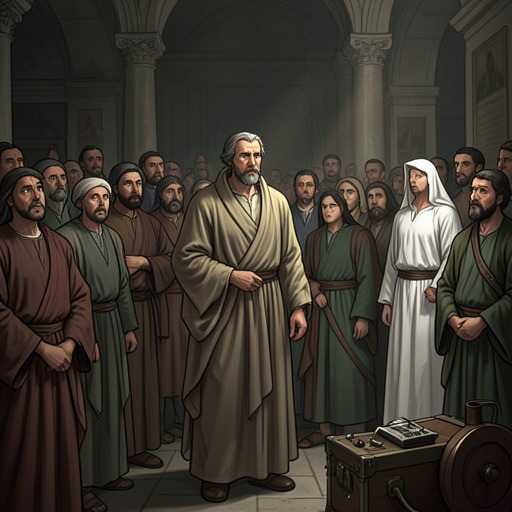
Khalid
The Satanic VersesKhalid is a water-carrier in Jahilia who becomes one of Mahound’s earliest followers and, later, his military chief of staff. His position makes him a figure of sharp reversals: in a city that depends on water but despises those who carry it, he begins as a necessary outcast and rises to enforce the authority of the order that once made him an object of contempt. His story connects the material vulnerability of Jahilia to the religious and political upheavals that transform it.
Identity and Background
Jahilia is built from sand, and water is both indispensable and feared: the city’s laws punish its careless spilling because it can erode roads and buildings. Water-carriers are therefore essential but treated as pariahs. Khalid draws water from Zamzam, a spring beside the House of the Black Stone, at the heart of the city. His work puts him in daily contact with the resource around which Jahilia’s anxieties gather, while his low status places him far from the authority held by its merchant class and temples.
At the graves of Hagar and Ismail, Abu Simbel identifies Khalid, Bilal, and Salman the Persian as targets for Baal’s verses. The three men represent the social margins of Jahilia: a water-carrier, an immigrant from Persia, and a formerly enslaved man whom Mahound freed. Abu Simbel dismisses them as insignificant, but their presence together also makes visible the unlikely constituency of Mahound’s growing movement. Khalid’s later rise from this circle to military command gives that early contrast particular force.
Among Mahound’s First Followers
Khalid appears with Bilal and Salman at Zamzam, washing before prayer. In Jahilia, where people accept the omnipotence of sand, their repeated ablutions and attachment to water make them conspicuous. Baal circles the group and mocks them, but Salman answers calmly, while Khalid remains jumpy. When Hamza approaches, Khalid runs to him with questions about Mahound’s absence and fears that the Prophet may be in danger.
The exchange reveals both Khalid’s loyalty and the strain it places on him. Bilal expresses faith in Mahound, while Hamza cautions that the Messenger is a man and that faith belongs to God. Khalid takes this as a possible accusation of weakness and challenges Hamza. Hamza rebukes him for letting fear show, but Khalid’s agitation persists. When Mahound returns, Khalid is among those gathered around him. After Mahound says that Abu Simbel has made an offer, Khalid reacts bitterly, calling it tempting; his response contributes to the unease among the followers as they confront the possibility of a religious compromise.
Khalid’s place in this group is especially exposed during Mahound’s public recitation in the poetry tent. Mahound recites verses that acknowledge the patron goddesses of Jahilia, and Abu Simbel and Hind kneel. The movement spreads through the gathering until the crowd, inside and outside the tent, is on its knees. Khalid has remained by the open tent flap. Horrified by what he sees, he flees through the city. His tears burn holes in the ground, an image that joins his personal distress to Jahilia’s perilous relation with water: the carrier of the city’s vital fluid becomes, in grief, another source of erosion.
From Water-Carrier to Military Leader
Later episodes place Khalid within the changed order of Mahound’s movement. During Gibreel Farishta’s dream of Mahound’s return to Jahilia, Khalid and Bilal lead Abu Simbel, who has come alone, to Mahound’s quarters. Abu Simbel has surrendered the city, and Khalid’s role in bringing him before the Prophet marks a reversal from the earlier scene in which the Grandee treated Khalid as one of the city’s contemptible outsiders.
In another dream, Mahound orders Khalid to cleanse the Temple of Uzza near Jahilia’s open gates. Khalid leads a force of men there. The temple’s guardian appeals to the idol for protection, but when it does not move, he concludes that the stone is not a goddess. Khalid breaks the temple and idol, then returns to report what happened. Mahound says the work is incomplete and sends him back. This time, an enormous woman appears and recites the verses associated with Lat, Manat, and Uzza. Khalid identifies them as the Devil’s verses and kills the apparition. When he reports this second encounter, Mahound agrees that they can enter Jahilia. The episode, explicitly presented as Gibreel’s dream, turns Khalid’s new authority into an ordeal: he is made not simply to destroy a sanctuary, but to distinguish between an inert idol and a threatening presence.
Khalid’s rise is also reflected in his later title as Mahound’s general and military chief of staff. When Salman the Persian is brought before Mahound during the conversions in Jahilia, Khalid has found him and accuses him of having been with a prostitute without the money to pay and of smelling of alcohol. Mahound begins to pronounce a death sentence, but Bilal intercedes, and Salman is allowed to live. Khalid’s part in the episode is practical and disciplinary: he tracks down a former companion of the movement who had fled after altering the revelations, and brings him to the Prophet’s judgment.
Loyalty, Authority, and Unfinished Pursuit
Khalid’s service does not make him a reliable interpreter of Mahound’s wishes. After Salman’s pardon, Mahound remains preoccupied with Baal, the poet who had mocked the early followers and later evaded capture. Khalid asks whether he should search for Baal and signals possible lethal punishment. Mahound calls him a fool for failing to work out what is wanted without instructions. The rebuke exposes a gap between Khalid’s forceful loyalty and the Prophet’s unspoken intentions: Khalid is ready to act, but cannot always tell what action Mahound desires.
Even so, Khalid undertakes an extensive search. He orders door-to-door searches and proclamations, turning over every apparent lead, but Baal cannot be found. Khalid eventually gives up, still vowing that he will deal with the poet if he appears. The pursuit remains unresolved in the available account, as does Mahound’s response to Baal’s escape. Khalid’s trajectory therefore ends not in a settled personal resolution but in a position of power shadowed by unfinished business. The former water-carrier, once mocked alongside the city’s other outsiders, has become an agent of the new regime; yet his repeated concern with obedience, fear, and punishment shows how precarious that transformation remains.